

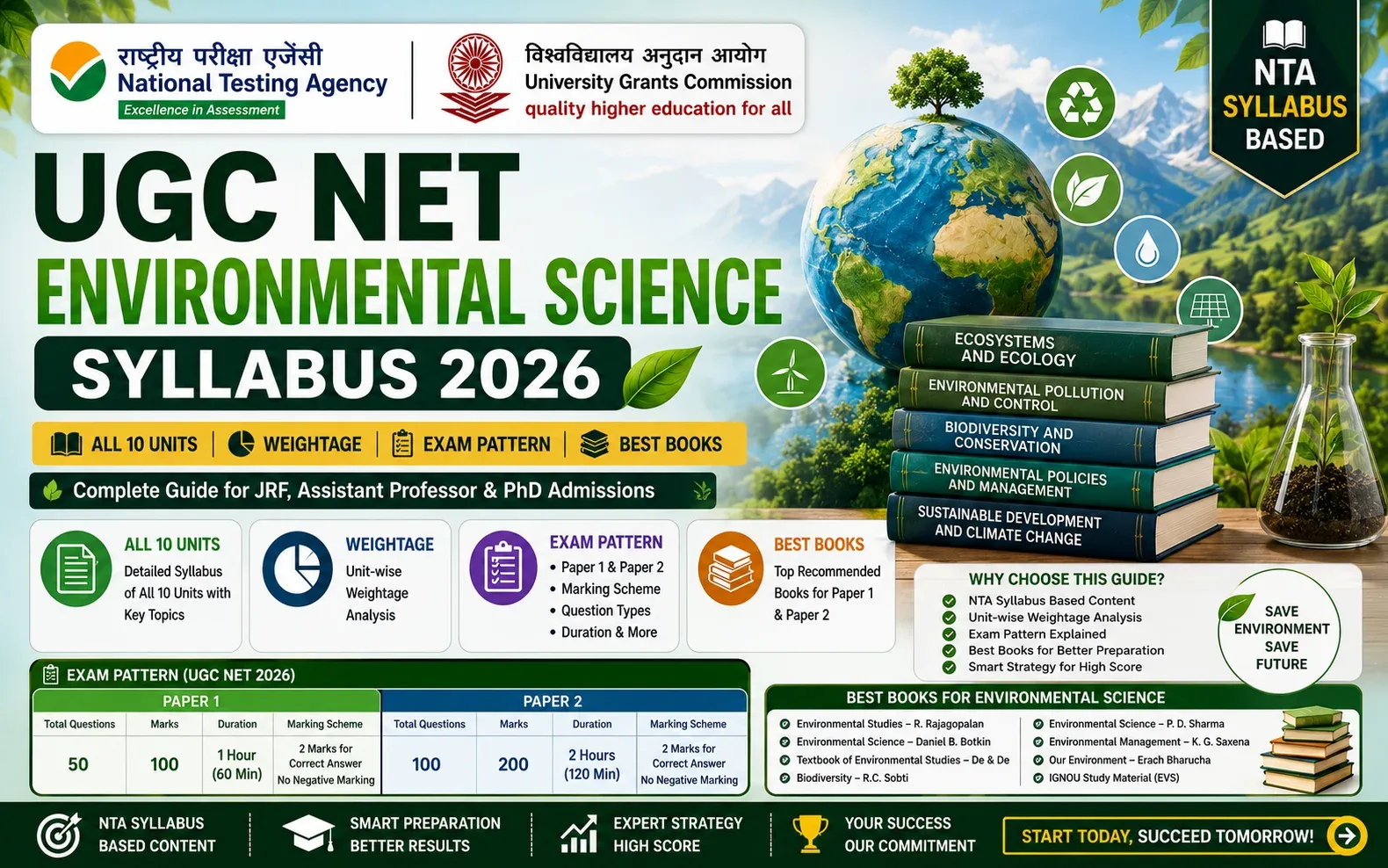
UGC NET Environmental Science Syllabus 2026
Your complete guide to all 10 units, unit-wise weightage, exam pattern, high-yield topics and the best books to crack Paper 2 for Assistant Professor & JRF.
Quick Highlights
| Particular | Details |
|---|---|
| Exam Name | UGC NET Environmental Science |
| Conducting Body | National Testing Agency (NTA) |
| Subject Code | 89 |
| Total Units | 10 |
| Mode | Computer-Based Test (CBT) |
| Negative Marking | No |
Exam Pattern & Marking Scheme
| Paper | Questions | Marks |
|---|---|---|
| Paper 1 (Teaching & Research Aptitude) | 50 MCQs | 100 |
| Paper 2 (Environmental Science) | 100 MCQs | 200 |
| Total | 150 MCQs | 300 |
Unit-Wise Weightage Analysis
Approximate number of questions expected from each unit based on previous-year trends. Prioritise the high-load units first.
| Unit | Expected Questions |
|---|---|
| Unit 6: Environmental Pollution & Control | 10–15 |
| Unit 3: Environmental Biology | 10–12 |
| Unit 8: Assessment, Management & Legislation | 10–12 |
| Unit 1: Fundamentals of Environmental Sciences | 8–12 |
| Unit 2: Environmental Chemistry | 8–10 |
| Unit 4: Environmental Geosciences | 8–10 |
| Unit 10: Contemporary Environmental Issues | 8–10 |
| Unit 5: Energy and Environment | 7–9 |
| Unit 7: Solid & Hazardous Waste Management | 6–8 |
| Unit 9: Statistical Approaches & Modelling | 6–8 |
Paper 2: Environmental Science Syllabus — All 10 Units
Unit 1 • Fundamentals of Environmental Sciences
Core concepts, earth systems and the foundations of sustainability.
- Thermodynamics and environmental ethics
- Meteorology and atmospheric processes
- Earth systems and natural resources
- Sustainable development principles
- Remote Sensing and GIS basics
Unit 2 • Environmental Chemistry
The chemistry of air, water, soil and pollutants.
- Analytical techniques in environmental chemistry
- Toxic chemicals and their behaviour
- Atmospheric (air) chemistry
- Hydrological cycle and water chemistry
- Soil chemistry and biogeochemical cycles
Unit 3 • Environmental Biology
Ecology, ecosystems and biodiversity — a high-scoring unit.
- Ecology, ecosystems and biomes
- Population and community ecology
- Biodiversity and its conservation
- Environmental toxicology
- Environmental microbiology
Unit 4 • Environmental Geosciences
Earth processes, hydrology and natural hazards.
- Hydrology and groundwater studies
- Natural hazards and disasters
- Earth processes and plate tectonics
- Weathering and soil formation
- Geochemical cycles
Unit 5 • Energy and Environment
Energy sources and their environmental impact.
- Renewable energy sources
- Fossil fuels and their impact
- Nuclear energy and hydropower
- Bioenergy and biofuels
- Global warming and energy transition
Unit 6 • Environmental Pollution and Control
The highest-weightage unit — all forms of pollution.
- Air pollution: sources, effects and control
- Water pollution and treatment
- Soil and noise pollution
- Thermal and marine pollution
- Radioactive pollution and control technologies
Unit 7 • Solid and Hazardous Waste Management
Handling, treatment and recycling of wastes.
- Solid waste management
- Hazardous waste management
- Plastic waste and e-waste
- Fly ash management
- Recycling and composting
Unit 8 • Environmental Assessment, Management & Legislation
Laws, EIA and policy — another high-weightage unit.
- Environmental laws and Acts
- Environmental Impact Assessment (EIA)
- Environmental audit and risk assessment
- Environmental policies
- International conventions and protocols
Unit 9 • Statistical Approaches and Modelling
Quantitative tools for environmental analysis.
- Sampling techniques
- Probability and distributions
- Correlation and regression
- Hypothesis testing
- Population models and environmental statistics
Unit 10 • Contemporary Environmental Issues
Current, application-based and emerging themes.
- Climate change and carbon credits
- Water and forest conservation
- Wildlife conservation
- Environmental disasters
- Sustainable Development Goals and current issues
High-Yield Topics to Master First
Secure these repeatedly asked areas before anything else:
Best Books for UGC NET Environmental Science
- Trueman’s UGC NET Environmental Science — comprehensive Paper 2 coverage
- Environmental Science — Y. K. Singh / S. C. Santra
- Environmental Chemistry — A. K. De
- Fundamentals of Ecology — Eugene P. Odum
- R. Gupta’s UGC NET Environmental Science practice sets
- UGC NET Environmental Science previous year question papers