

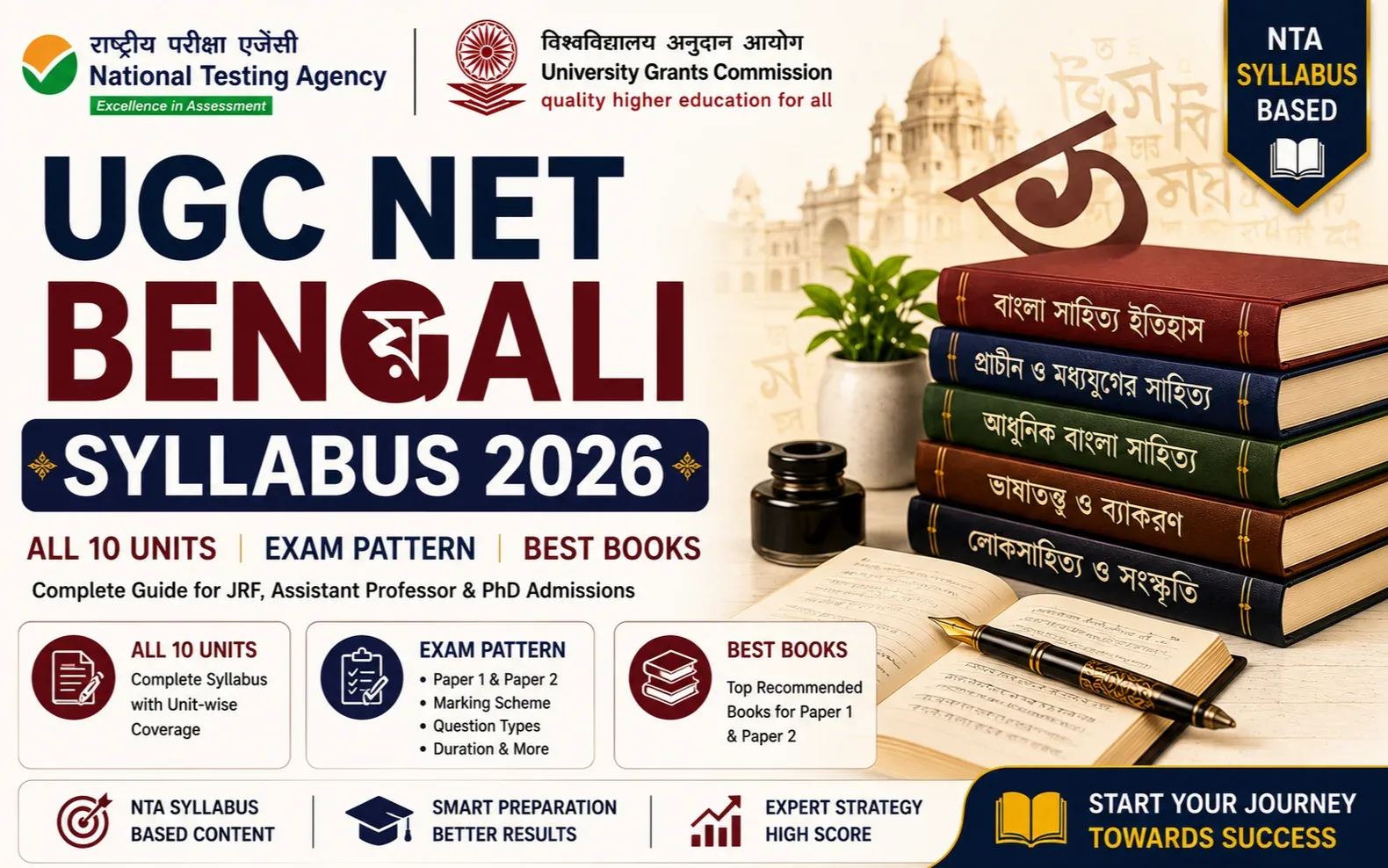
UGC NET Bengali Syllabus 2026
Your complete guide to all 10 units, exam pattern, key focus areas and the best books to crack Paper 2 for Assistant Professor & JRF.
Quick Highlights
| Particular | Details |
|---|---|
| Exam Name | UGC NET Bengali |
| Conducting Body | National Testing Agency (NTA) |
| Subject Code | 19 |
| Total Units | 10 |
| Mode | Computer-Based Test (CBT) |
| Negative Marking | No |
Exam Pattern (Paper 1 & Paper 2)
| Paper | Questions | Marks |
|---|---|---|
| Paper 1 (Teaching & Research Aptitude) | 50 MCQs | 100 |
| Paper 2 (Bengali) | 100 MCQs | 200 |
| Total | 150 MCQs | 300 |
Paper 2: Bengali Syllabus — All 10 Units
Unit 1 • Origin & Development of the Bengali Language (বাংলা ভাষার উদ্ভব ও ক্রমবিকাশ)
The linguistic foundation — phonology, morphology and the growth of Bengali.
- Bengali phonology; classification of vowels and consonants
- Nature and structure of syllables
- Formation of words and suffixes (pratyaya)
- Historical development of the Bengali language
Unit 2 • Pre-Modern Bengali Literature (প্রাগাধুনিক বাংলা সাহিত্য)
The earliest and medieval phases of Bengali literary tradition.
- Charyapada — the earliest specimen of Bengali literature
- Rameshwar Bhattacharya — Shibayan (Chashapala)
- Themes and features of pre-modern literature
Unit 3 • Poetry (কাব্য কবিতা)
Major poets and poetical works of Bengali literature.
- Ishwar Chandra Gupta — selected poems (Tattva, Snanjatra and others)
- Michael Madhusudan Dutt — Meghnad Badh Kavya
- Biharilal Chakraborty — Sadher Ason
- Samar Sen — Meghdoot, Mahuar Desh, Urvashi and others
Unit 4 • Sketches & Novels (নকশা ও উপন্যাস)
The rise of the Bengali novel and narrative prose.
- Bankim Chandra Chattopadhyay — Bishabriksha
- Tarashankar Bandyopadhyay — Radha
- Bibhutibhushan Bandyopadhyay — Pather Panchali
Unit 5 • Short Story (ছোটোগল্প)
The Bengali short-story form and its leading writers.
- Banaphul — selected stories (Sripati Samanta and others)
- Premendra Mitra — Masha (Ghanada), Sansar Simante
- Themes and craft of the Bengali short story
Unit 6 • Drama & Farce (নাটক ও প্রহসন)
Bengali theatre — serious drama and social satire.
- Michael Madhusudan Dutt — Ekei Ki Bole Sabhyata
- Mir Mosharraf Hossain — Jamidar Darpan
- Development of Bengali drama and farce
Unit 7 • Essay, Belles-lettres, Autobiography & Periodical Prose (প্রবন্ধ, রম্যরচনা, আত্মজীবনী ও সাময়িকপত্র)
Prose forms — essays, memoirs and periodical writing.
- Rammohan Roy — debate on Sahamaran (Sati): first proposal
- Swami Vivekananda — Prachya O Pashchatya (East and West)
- Growth of Bengali essay and periodical prose
Unit 8 • Rabindra-Literature (রবীন্দ্রসাহিত্য)
A focused study of Rabindranath Tagore’s poetic works.
- Chitra (চিত্রা) — poetry collection
- Punashcha (পুনশ্চ) — poetry collection
- Themes, forms and significance of Tagore’s poetry
Unit 9 • Prosody & Rhetoric (ছন্দ অলংকার)
The metrics and figures of speech of Bengali poetry.
- Origin and development of Bengali metre (chhanda)
- Rules and varieties of Bengali prosody
- Figures of speech (alankara) and their use
Unit 10 • Indian & Western Poetics (ভারতীয় ও পাশ্চাত্য কাব্যতত্ত্ব)
Classical theories of literature, Indian and Western.
- Alankaravada, Ritivada, Rasavada and Dhvanivada
- Chitrakavya and Vakroktivada
- Aristotle — Poetics
Key Focus Areas to Master First
Prioritise these frequently tested areas across literary history, theory and texts:
Best Books for UGC NET Bengali
- Bangla Sahityer Itihas (History of Bengali Literature) — Sukumar Sen
- Bangla Sahityer Sampurna Itibritta — Asit Kumar Bandyopadhyay
- Bhasha-Prakash Bangala Vyakaran — Suniti Kumar Chatterjee (language & grammar)
- Chhanda O Alankar — standard prosody and rhetoric texts
- Prescribed primary texts (Charyapada, Meghnad Badh Kavya, Pather Panchali, Tagore’s Chitra & Punashcha)
- UGC NET Bengali previous year question papers