

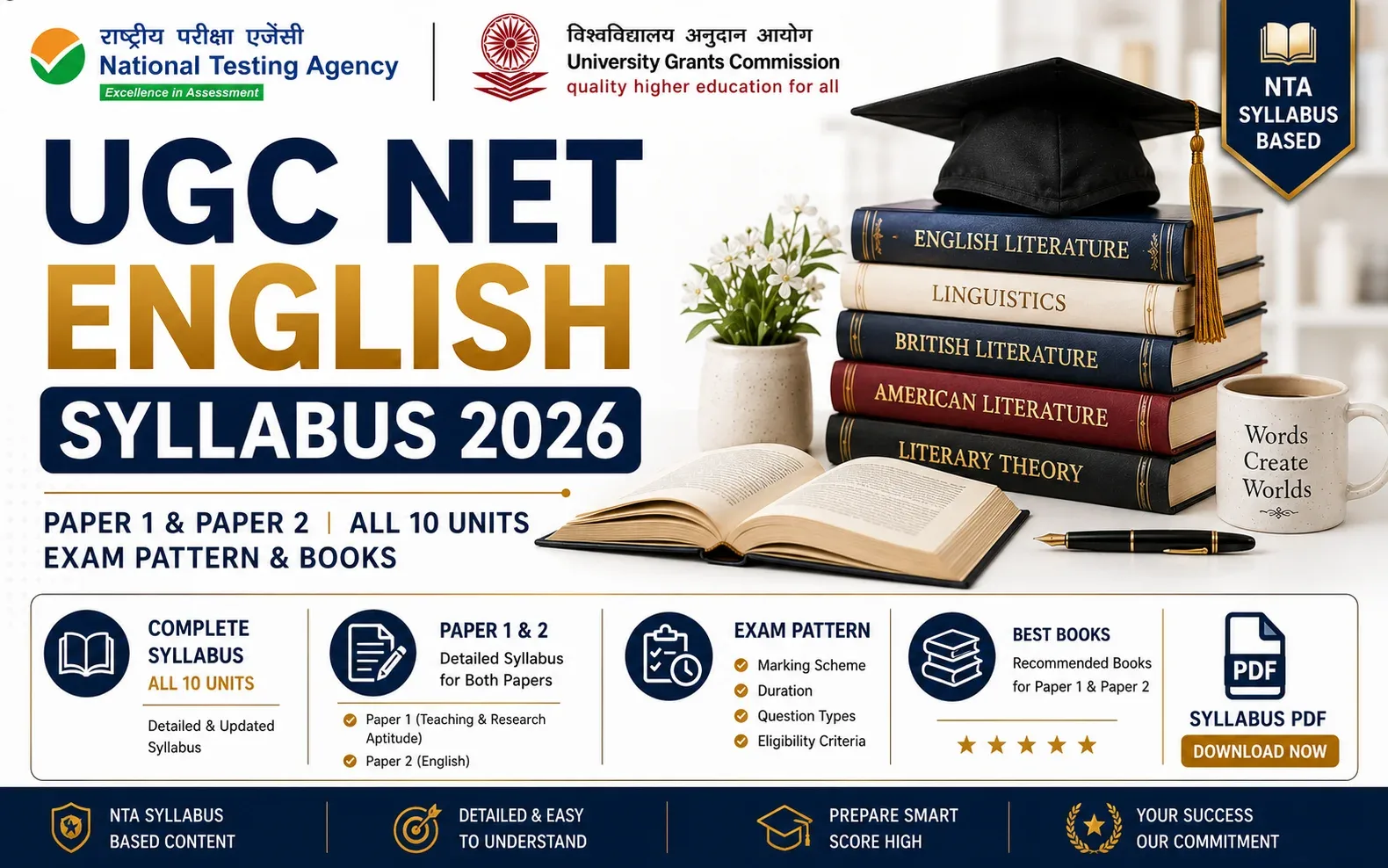
UGC NET English Syllabus 2026
Paper 1 & Paper 2 • All 10 Units • Exam Pattern • Best Books • Preparation Strategy
A clear understanding of the UGC NET English Syllabus 2026 is the foundation of smart preparation. English Literature (Subject Code 30) is a wide subject covering British, American, Indian and Postcolonial literature, along with literary theory, linguistics, cultural studies and research methods. In this guide we explain the full syllabus for Paper 1 and Paper 2, break down all 10 units topic-by-topic, cover the exam pattern, list high-weightage units and trusted books, and share a practical study plan — all in simple language.
UGC NET English 2026: Quick Highlights
UGC NET English Exam Pattern 2026
Both papers are held in one 3-hour session. Each correct answer gives +2 marks with no negative marking, so attempting every question is worthwhile. Paper 2 alone carries 200 of the 300 total marks.
Paper 2: English Literature Syllabus — All 10 Units
The English Literature Paper 2 syllabus is divided into 10 units covering literature, language, criticism, theory and research. Questions can come from any unit, so cover them all. Here is a topic-wise breakdown:
Unit I • Drama
- Major dramatic periods from Classical Greek to Contemporary drama
- Key playwrights – Sophocles, Shakespeare, Chekhov, Tennessee Williams
- Dramatic movements and techniques
- Aristotelian vs Brechtian (epic) dramatic theory
- Restoration drama and prescribed texts such as Hamlet
Unit II • Poetry
- Poetry from Old English to Contemporary literature
- Major poets – Milton, Coleridge, T. S. Eliot, Neruda, Walcott, Tagore
- Poetic forms, metre and literary devices
- Movements – Romanticism, Modernism and Postcolonial poetry
Unit III • Fiction and Short Story
- Development of the novel and short story
- Narrative techniques and points of view
- Realism, Modernism and Postmodernism
- Major British, American, Indian and Postcolonial novelists
- Key texts – works of Austen, Marquez, Achebe, Dostoevsky
Unit IV • Non-Fictional Prose
- Essays, autobiography and biography
- Travel writing and political prose
- Rhetoric and forms of prose
- Major non-fiction writers such as Nehru, Darwin and Harari
Unit V • English Language: Concepts & Pedagogy
- Basics of linguistics – phonetics, syntax and semantics
- Language acquisition and learning
- English Language Teaching (ELT) methodologies
- Applied linguistics and pedagogy
Unit VI • English in India: History & Development
- History and growth of English in India
- Present status of English in India
- Indian Writing in English
- Language policies
- Major Indian English authors – Tagore, Arundhati Roy and others
Unit VII • Cultural Studies
- Identity, ideology and representation
- Media, gender, race and class
- Postcolonial theory
- Dalit literature and marginalised voices
- Key thinkers – Fanon, Du Bois and C. L. R. James
Unit VIII • Literary Criticism
- Classical, modern and Indian literary criticism
- Aristotle’s Poetics and the concept of catharsis
- Sidney’s A Defence of Poesy
- Pope’s An Essay on Criticism
- Major critics, schools and literary concepts
Unit IX • Post-WWII Literary Theories
- Structuralism and Post-structuralism
- Feminism and Marxism
- Psychoanalysis
- Ecocriticism
- Postcolonial theory and application-based analysis
Unit X • Research Methods in English
- Research methodology and design
- Research ethics
- Scholarly and academic writing
- Citation, referencing and literature review
High-Weightage Units in UGC NET English
There is no official weightage, but previous-year analysis shows some units contribute more questions. Prioritise these while covering the whole syllabus:
Important Authors to Study
- Drama: Shakespeare, Samuel Beckett, Bertolt Brecht, Girish Karnad
- Poetry: Chaucer, Milton, Wordsworth, T. S. Eliot, Kamala Das
- Fiction: Jane Austen, Charles Dickens, Virginia Woolf, Salman Rushdie
- Literary Theory: Aristotle, Derrida, Foucault, Edward Said, Judith Butler
Best Books for UGC NET English 2026
- A History of English Literature – Edward Albert
- The Norton Anthology of English Literature (for texts)
- Literary Criticism and Theory – M. A. R. Habib / Peter Barry (Beginning Theory)
- Trueman’s UGC NET/SET English Literature
- Previous-year question papers and mock tests
Tip: Read primary texts wherever possible and pair them with a standard criticism/theory guide — direct textual and factual questions are common.
How to Prepare: Smart Study Strategy
1. Finish one unit per week: Plan your schedule so all ten units are covered with time left for revision.
2. Study Paper 1 daily: Don’t leave the 100-mark aptitude paper for the end — practise it alongside literature.
3. Master theory & criticism: Revise literary theories and critics repeatedly, as these carry high weightage.
4. Make author & movement notes: Keep short notes on important authors, works and literary movements for quick revision.
5. Solve PYQs & weekly mocks: Practise previous-year papers and take weekly mock tests to build accuracy and speed.