
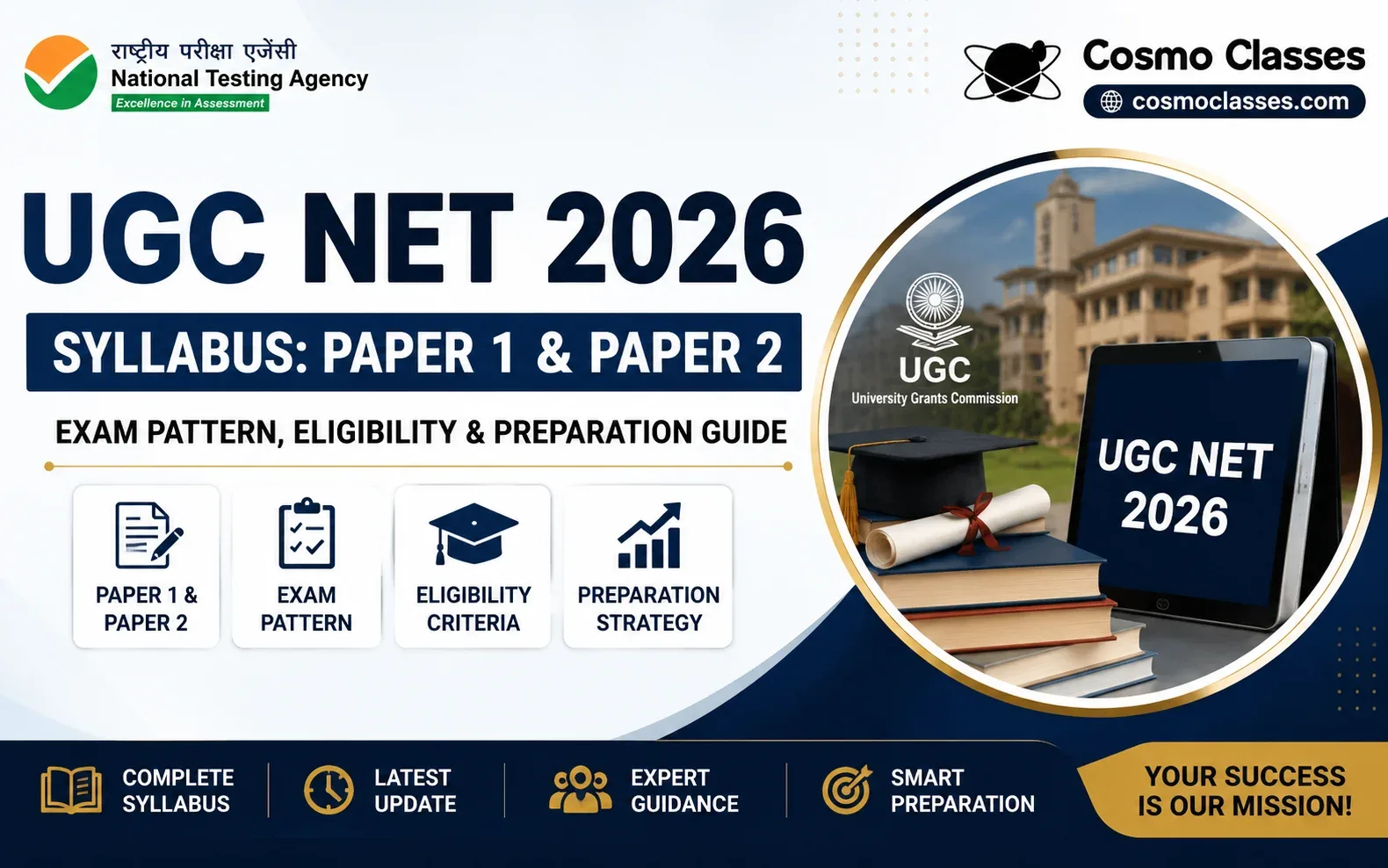
The UGC NET (University Grants Commission National Eligibility Test) is the national-level exam for candidates aspiring to become Assistant Professors and to qualify for the Junior Research Fellowship (JRF) in Indian universities and colleges. Conducted by the National Testing Agency (NTA) twice a year (June and December cycles), the exam is a Computer-Based Test (CBT). This guide covers the complete UGC NET 2026 Syllabus for Paper 1 & Paper 2, the exam pattern, eligibility, subject list and expert preparation tips.
Quick Overview: UGC NET 2026 has two papers. Paper 1 tests teaching & research aptitude (50 MCQs, 100 marks) and Paper 2 tests your chosen subject (100 MCQs, 200 marks). Candidates can choose from 85+ subjects.
UGC NET 2026 Exam Pattern
The exam is conducted online (CBT) with no break between Paper 1 and Paper 2. Both papers contain objective-type, multiple-choice questions with no negative marking.
| Paper | Questions | Marks | Duration |
|---|---|---|---|
| Paper 1 (Teaching & Research Aptitude) | 50 | 100 | 3 Hours (Combined, no break) |
| Paper 2 (Subject Specific) | 100 | 200 | |
| Total | 150 | 300 | 3 Hours |
UGC NET 2026 Eligibility Criteria
- Assistant Professor: Master's degree with at least 55% marks (50% for reserved categories & PwD).
- JRF: Same qualification, with an upper age limit of 30 years (relaxation as per rules).
- No age limit for the Assistant Professor eligibility.
- Final-year Master's students may also apply (provisionally).
UGC NET Paper 1 Syllabus 2026 (Units 1–10)
Paper 1 is common to all candidates and consists of 10 units, each carrying 5 questions (10 marks). It assesses teaching & research aptitude and general awareness.
Unit 1: Teaching Aptitude
Concept, objectives & levels of teaching; learner characteristics; factors affecting teaching; teacher-centred vs learner-centred methods; Swayam, Swayamprabha, MOOCs; teaching support systems; and evaluation systems (including CBCS & computer-based testing).
Unit 2: Research Aptitude
Meaning, types & characteristics of research; positivism & post-positivism; methods (experimental, descriptive, historical, qualitative, quantitative); steps of research; thesis & article writing; application of ICT in research; and research ethics.
Unit 3: Reading Comprehension
A passage is given and questions are asked based on it, testing comprehension and interpretation skills.
Unit 4: Communication
Meaning, types & characteristics of communication; verbal & non-verbal, intercultural, group & classroom communication; barriers to effective communication; and mass media & society.
Unit 5: Mathematical Reasoning & Aptitude
Types of reasoning; number series, letter series, codes & relationships; and mathematical aptitude (fractions, time & distance, ratio, proportion, percentage, profit & loss, interest, averages).
Unit 6: Logical Reasoning
Structure of arguments; categorical propositions, mood & figure; formal & informal fallacies; Venn diagrams; and Indian Logic — Pramanas (Pratyaksha, Anumana, Upamana, Shabda, Arthapatti, Anupalabddhi).
Unit 7: Data Interpretation
Sources, acquisition & classification of data; quantitative & qualitative data; graphical representation (bar, histogram, pie, table, line charts); data interpretation; and data & governance.
Unit 8: Information & Communication Technology (ICT)
ICT abbreviations & terminology; basics of Internet, Intranet, e-mail, audio & video conferencing; digital initiatives in higher education; and ICT & governance.
Unit 9: People, Development & Environment
This is often the highest-scoring section. Covers sustainable development goals; human-environment interaction; pollution & its impacts; natural & energy resources; disasters & mitigation; and key agreements (Montreal Protocol, Kyoto Protocol, Paris Agreement, International Solar Alliance).
Unit 10: Higher Education System
Institutions of higher learning in ancient India; evolution of higher education post-independence; oriental & conventional learning; professional & skill-based education; value & environmental education; and governance, polity & administration.
UGC NET Paper 2 Syllabus 2026 (Subject-Wise)
Paper 2 is based on the subject chosen by the candidate at the time of application. It has 100 MCQs for 200 marks, and the NTA conducts UGC NET across 85+ subjects. Below are some of the most popular subjects and their subject codes:
| Code | Subject | Official Syllabus Link |
|---|---|---|
| All | General Paper | Official Syllabus |
| 01 | Economics / Rural Economics /Co-operation / Demography / Development Planning/ Development Studies / Econometrics/ Applied Economics/Development Eco./Business Economics | Official Syllabus |
| 02 | Political Science | Official Syllabus |
| 03 | Philosophy | Official Syllabus |
| 04 | Psychology | Official Syllabus |
| 05 | Sociology | Official Syllabus |
| 06 | History | Official Syllabus |
| 07 | Anthropology | Official Syllabus |
| 08 | Commerce | Official Syllabus |
| 09 | Education | Official Syllabus |
| 10 | Social Work | Official Syllabus |
| 11 | Defence and Strategic Studies | Official Syllabus |
| 12 | Home Science | Official Syllabus |
| 14 | Public Administration | Official Syllabus |
| 15 | Population Studies | Official Syllabus |
| 16 | Music | Official Syllabus |
| 17 | Management (including Business Admin. Mgt./Marketing/ Marketing Mgt./Industrial Relations and Personnel Mgt./ Personnel Mgt./Financial Mgt./Co-operative Management) | Official Syllabus |
| 18 | Maithili | Official Syllabus |
| 19 | Bengali | Official Syllabus |
| 20 | Hindi | Official Syllabus |
| 21 | Kannada | Official Syllabus |
| 22 | Malayalam | Official Syllabus |
| 23 | Oriya | Official Syllabus |
| 24 | Punjabi | Official Syllabus |
| 25 | Sanskrit | Official Syllabus |
| 26 | Tamil | Official Syllabus |
| 27 | Telugu | Official Syllabus |
| 28 | Urdu | Official Syllabus |
| 29 | Arabic | Official Syllabus |
| 30 | English | Official Syllabus |
| 31 | Linguistics | Official Syllabus |
| 32 | Chinese | Official Syllabus |
| 33 | Dogri | Official Syllabus |
| 34 | Nepali | Official Syllabus |
| 35 | Manipuri | Official Syllabus |
| 36 | Assamese | Official Syllabus |
| 37 | Gujarati | Official Syllabus |
| 38 | Marathi | Official Syllabus |
| 39 | French (French Version) | Official Syllabus |
| 40 | Spanish | Official Syllabus |
| 41 | Russian | Official Syllabus |
| 42 | Persian | Official Syllabus |
| 43 | Rajasthani | Official Syllabus |
| 44 | German | Official Syllabus |
| 45 | Japanese | Official Syllabus |
| 46 | Adult Education/ Continuing Education/ Andragogy/Non-Formal Education. | Official Syllabus |
| 47 | Physical Education | Official Syllabus |
| 49 | Arab Culture and Islamic Studies | Official Syllabus |
| 50 | Indian Culture | Official Syllabus |
| 55 | Labour Welfare/Personnel Management/Industrial Relations/ Labour and Social Welfare/Human Resource Management | Official Syllabus |
| 58 | Law | Official Syllabus |
| 59 | Library and Information Science | Official Syllabus |
| 60 | Buddhist, Jaina, Gandhian, and Peace Studies | Official Syllabus |
| 62 | Comparative Study of Religions | Official Syllabus |
| 63 | Mass Communication and Journalism | Official Syllabus |
| 65 | Performing Art - Dance/Drama/Theatre | Official Syllabus |
| 66 | Museology & Conservation | Official Syllabus |
| 67 | Archaeology | Official Syllabus |
| 68 | Criminology | Official Syllabus |
| 70 | Tribal and Regional Language/Literature | Official Syllabus |
| 71 | Folk Literature | Official Syllabus |
| 72 | Comparative Literature | Official Syllabus |
| 73 | Sanskrit traditional subjects (including) Jyotisha/Sidhanta Jyotish/ Navya Vyakarna/ Vyakarna/ Mimansa/ Navya Nyaya/ Sankhya Yoga/Tulanatmaka Darsan/ Shukla Yajurveda/ Madhav Vedant/ Dharmasasta/ Sahitya/ Puranotihasa /Agama). | Official Syllabus |
| 74 | Women Studies | Official Syllabus |
| 79 | Visual Art (including Drawing & Painting/Sculpture, Graphics/Applied Art/History of Art) | Official Syllabus |
| 80 | Geography | Official Syllabus |
| 81 | Social Medicine & Community Health | Official Syllabus |
| 82 | Forensic Science | Official Syllabus |
| 83 | Pali | Official Syllabus |
| 84 | Kashmiri | Official Syllabus |
| 85 | Konkani | Official Syllabus |
| 87 | Computer Science and Applications | Official Syllabus |
| 88 | Electronic Science | Official Syllabus |
| 89 | Environmental Sciences | Official Syllabus |
| 90 | Politics, including International Relations/International Studies, including Defence/Strategic Studies, West Asian Studies, South East Asian Studies, African Studies, South Asian Studies, Soviet Studies, and American Studies. | Official Syllabus |
| 91 | Prakrit | Official Syllabus |
| 92 | Human Rights and Duties | Official Syllabus |
| 93 | Tourism Administration and Management | Official Syllabus |
| 94 | Bodo | Official Syllabus |
| 95 | Santali | Official Syllabus |
| 100 | Yoga | Official Syllabus |
| 101 | Sindhi | Official Syllabus |
| 102 | Hindu Studies | Official Syllabus |
| 103 | Indian Knowledge System | Official Syllabus |
| 104 | Disaster Management | Official Syllabus |
| 105 | Ayurveda Biology | Official Syllabus |
UGC NET 2026 Preparation Tips
- Understand the syllabus first: Map every unit before starting so no topic is missed.
- Focus on high-scoring units: People, Development & Environment and Higher Education System are scoring and factual.
- Practice previous year papers: Understand the question trend and difficulty level.
- Take regular mock tests: Build speed and accuracy for the 3-hour CBT.
- Revise current affairs & ICT: Especially digital education initiatives.
UGC NET 2026 Syllabus PDF & Official Links
Download the detailed syllabus and check official notifications only from these official government sources:
Explore More on Cosmo Classes
Keep your preparation on track with our free study resources and daily practice. Browse these related categories:
Start Your UGC NET 2026 Preparation with Cosmo Classes
Daily current affairs, subject notes, and practice quizzes — everything you need to crack UGC NET, all in one place.