

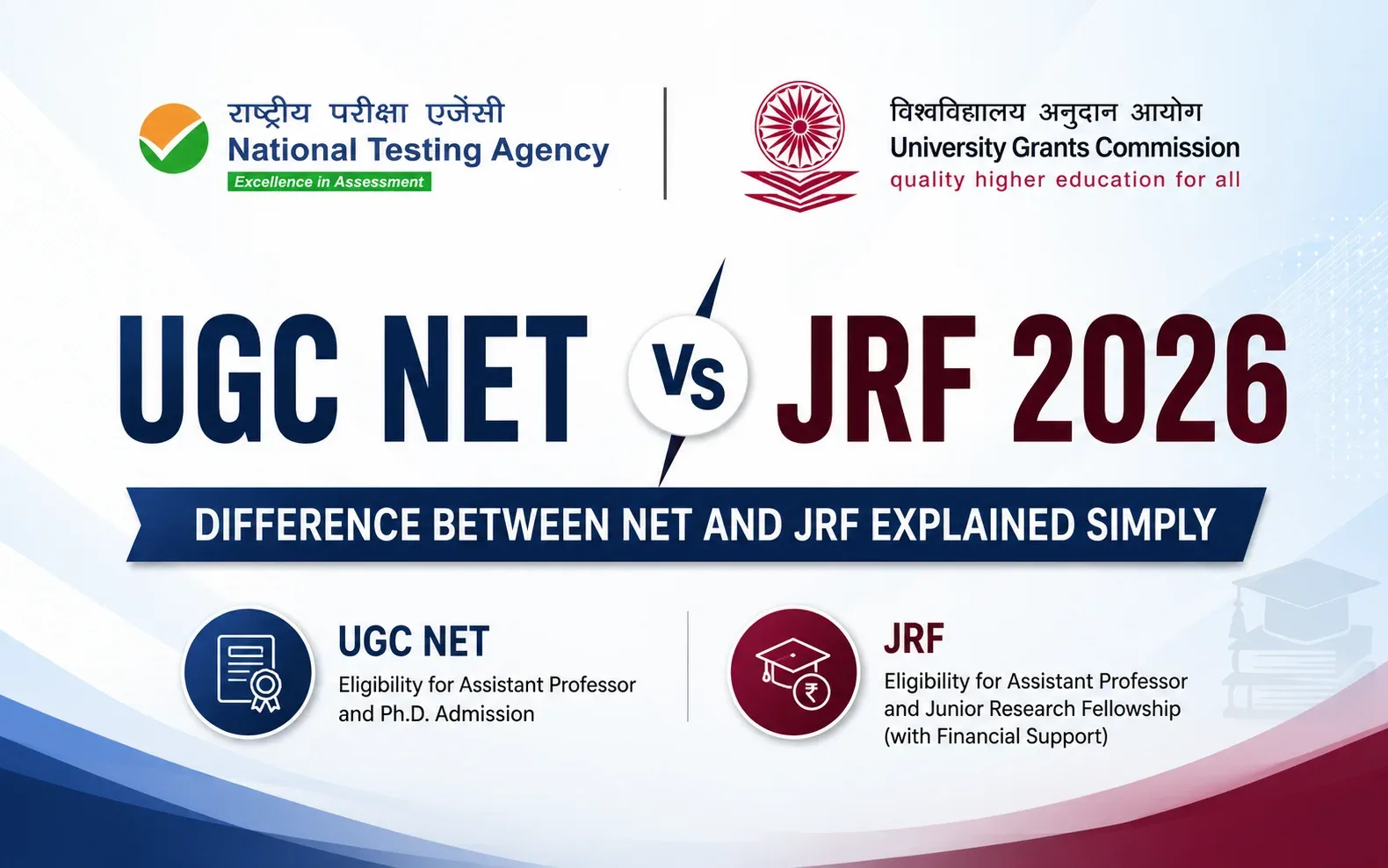
Quick summary: UGC NET and JRF come from the same exam conducted by the National Testing Agency (NTA). The difference lies in what you unlock after clearing it. NET makes you eligible to become an Assistant Professor, while JRF gives you a research fellowship with a monthly stipend to pursue a PhD. In short, JRF is the higher achievement, and you need more marks to earn it.
If you are preparing for the UGC NET 2026 exam, you have almost certainly come across two terms that sound similar but mean very different things: NET and JRF. Many students get confused and think they are two separate exams. They are not. Both are results of the same UGC NET examination. This guide breaks down the difference in the simplest possible way, so you know exactly what you are aiming for and what each qualification gives you in your career.
What is UGC NET?
UGC NET stands for University Grants Commission National Eligibility Test. It is a national-level exam conducted by the National Testing Agency (NTA) to decide whether a candidate is qualified to become an Assistant Professor in Indian universities and colleges, and to select candidates for the Junior Research Fellowship (JRF).
Think of UGC NET as a single doorway. When you walk through it successfully, you can end up in one of three positions depending on your score: NET qualified (Assistant Professor eligible), NET + JRF qualified, or not qualified. The exam is held twice a year, usually around June and December/January, in online computer-based (CBT) mode.
What is JRF?
JRF stands for Junior Research Fellowship. It is a prestigious fellowship awarded to the top-scoring candidates of the UGC NET exam. A JRF is not a separate test — it is a reward for scoring high enough in NET. Once you qualify for JRF, you receive a monthly stipend from the government to carry out research and pursue a PhD at a recognised university.
Simple way to remember it:
Everyone who clears JRF is automatically NET-qualified too — but not everyone who is NET-qualified gets JRF. JRF is like the “top rank” version of the same result.
UGC NET vs JRF: The Core Difference
The single biggest difference is the purpose. NET is about teaching eligibility. JRF is about funded research. Here is a clear side-by-side comparison.
| Point of Comparison | UGC NET | JRF |
|---|---|---|
| Full form | National Eligibility Test | Junior Research Fellowship |
| Main purpose | Eligibility to become an Assistant Professor | Funded fellowship to pursue PhD / research |
| Marks required | Lower cut-off | Higher cut-off (more competitive) |
| Financial benefit | No stipend | Monthly government stipend |
| Age limit | No upper age limit | Upper age limit applies (with relaxations) |
| Career direction | Teaching / lectureship | Research + teaching option |
Eligibility Criteria (Same for Both)
Because NET and JRF come from the same exam, the basic eligibility to appear is the same. The extra condition only applies to the JRF age limit.
- Educational qualification: A Master’s degree (or equivalent) with at least 55% marks.
- Relaxation: Reserved category candidates (SC/ST/OBC-NCL/PwD) get a 5% relaxation, so they need 50% marks.
- Final-year students: Candidates awaiting their result can also apply, subject to conditions.
- Age limit for JRF: Generally 30 years, with relaxation up to 5 years for SC/ST/PwD/female candidates and 3 years for OBC candidates. NET (Assistant Professor) has no upper age limit.
UGC NET & JRF Cut-Off Marks
To qualify, a candidate must first cross the minimum qualifying percentage in both papers combined. JRF is then awarded to the very top scorers within that qualified pool, based on a slot system decided by subject and category.
| Category | Minimum Qualifying Marks (Paper 1 + Paper 2 together) |
|---|---|
| General (UR) | 40% |
| OBC-NCL / SC / ST / PwD / EWS | 35% |
Important: Clearing the 40%/35% cut-off makes you NET-qualified. JRF, however, is decided separately — only a limited number of top scorers in each subject and category get the fellowship. So the JRF cut-off is always higher than the NET cut-off.
What Can You Do After Qualifying?
If you qualify NET only
You become eligible to apply for Assistant Professor posts in universities and colleges across India. You can start your teaching career once you clear the institution’s recruitment process.
If you qualify NET + JRF
You get the best of both worlds. You can pursue a PhD with a monthly stipend (the JRF tenure is generally up to 3 years, extendable as SRF), and you are also eligible for Assistant Professor posts. This is why JRF is considered the more valuable outcome.
UGC NET 2026 Eligibility Criteria in Detail
Before you apply, make sure you meet every condition. The eligibility for UGC NET 2026 is the same whether you aim for Assistant Professor or JRF, except for the age rule. Here is the complete checklist.
| Criteria | Requirement |
|---|---|
| Educational qualification | Master’s degree (or equivalent) with at least 55% marks |
| Relaxation in marks | 50% for SC / ST / OBC-NCL / PwD / Transgender candidates |
| Age limit (JRF) | Maximum 30 years (with relaxations); no upper age limit for Assistant Professor |
| Number of attempts | No limit on attempts for both JRF and Assistant Professor |
| Nationality | Must be an Indian citizen |
| Subject | Should match your post-graduation subject (or a closely related one) |
Final-year students can also apply. If you are in the final year of your Master’s or waiting for results, you may appear — but you must complete the degree with the required marks within two years of the result date. Professional qualifications like CA / CS / ICWA are treated as equivalent to a PG degree.
UGC NET 2026 Age Relaxation
The 30-year age limit for JRF is relaxed for several categories. Remember, this only applies to JRF — there is no age bar for the Assistant Professor role.
| Category | Age Relaxation |
|---|---|
| SC / ST | 5 years |
| OBC-NCL | 5 years |
| PwD / Transgender | 5 years |
| Women applicants | 5 years |
| LLM degree holders | 3 years |
| Research experience / Armed Forces | Up to 5 years |
UGC NET 2026 Admit Card
The UGC NET 2026 admit card is your entry pass to the exam hall. It is released by the NTA on the official website a few days before the exam, and no candidate is allowed to sit for the test without it.
- Download it from the official NTA UGC NET portal using your application number and date of birth / password.
- Check every detail carefully — name, photo, subject, exam date, shift timing and centre address.
- Carry a printed copy of the admit card along with a valid photo ID (Aadhaar, PAN, Passport, etc.).
- If you spot any mistake, contact the NTA helpline immediately for correction.
Tip: Reach your exam centre well before the reporting time. Late entry is not allowed once the gates close.
UGC NET 2026 Result & Selection Process
After the exam, the NTA releases the answer key, invites objections, and then declares the final result and scorecard. Selection follows a clear, step-wise process:
- Provisional answer key is published; candidates can raise objections within the given window.
- The final answer key is released and results are prepared based on it.
- Candidates crossing the qualifying cut-off are declared NET-qualified (Assistant Professor eligible).
- From this pool, the top scorers per subject and category are awarded JRF, based on available slots.
- Separate e-certificates are issued for NET and JRF qualification.
Career Options & Job Profile After UGC NET / JRF
Clearing UGC NET opens several career doors — from teaching and research to well-paid public sector roles.
Assistant Professor
Teach at government or private universities and colleges. A PhD is now optional (not mandatory) for this role as per the latest UGC rules.
Researcher (JRF)
Pursue a fully funded PhD with a monthly stipend and contribute original research in your subject.
Public Sector (PSU) Jobs
Many PSUs recruit UGC NET / JRF holders — including ONGC, NTPC, BHEL, IOCL, HPCL, BEL, Power Grid and Oil India. The JRF scorecard often acts as a shortlisting gateway.
UGC NET / JRF Salary Expectations
| Employer Type | Approximate Monthly Salary |
|---|---|
| Private Universities | ₹ 30,000 – ₹ 70,000 |
| Government Universities | ₹ 55,000 – ₹ 1,05,000 |
| Public Sector (PSU) | ₹ 60,000 – ₹ 1,80,000 |
A UGC NET qualified lecturer can typically expect an overall package (CTC) of around ₹ 11–12 lakhs per year, along with government perks and allowances.
UGC NET 2026 Reservation Policy
UGC NET follows the Government of India reservation policy. The reservation of seats/slots is broadly as follows:
- SC: 15%
- ST: 7.5%
- OBC-NCL: 27%
- EWS (General): 10%
- PwD: 5% (horizontal)
Which One Should You Aim For?
If your goal is a career in teaching, clearing NET is enough to begin. But if you dream of a research career, a funded PhD, or a role in academia with financial support, then you should aim for JRF. The smart strategy is simple: prepare as if you are targeting JRF. By aiming for the higher cut-off, you comfortably clear NET along the way and keep both doors open.
Cosmo Classes tip:
Focus on accuracy and speed in Paper 1 (teaching & research aptitude, reasoning, data interpretation) because it is scoring and common to everyone. Then build deep subject mastery in Paper 2. Consistent daily practice with previous year questions is the fastest route to a JRF-level score.
Frequently Asked Questions
Are NET and JRF two different exams?
No. Both come from the same UGC NET exam. Your score decides whether you get NET only or NET + JRF.
How many times is UGC NET held in a year?
Twice a year, usually around June and December/January, in online CBT mode.
Is there an age limit for NET?
There is no upper age limit for Assistant Professor eligibility (NET). The age limit applies only to JRF.
Does JRF also allow teaching?
Yes. JRF holders are also eligible for Assistant Professor / lectureship positions, in addition to their research fellowship.
Explore More on Cosmo Classes
Keep your preparation on track with our free study resources and daily practice. Browse these related categories: