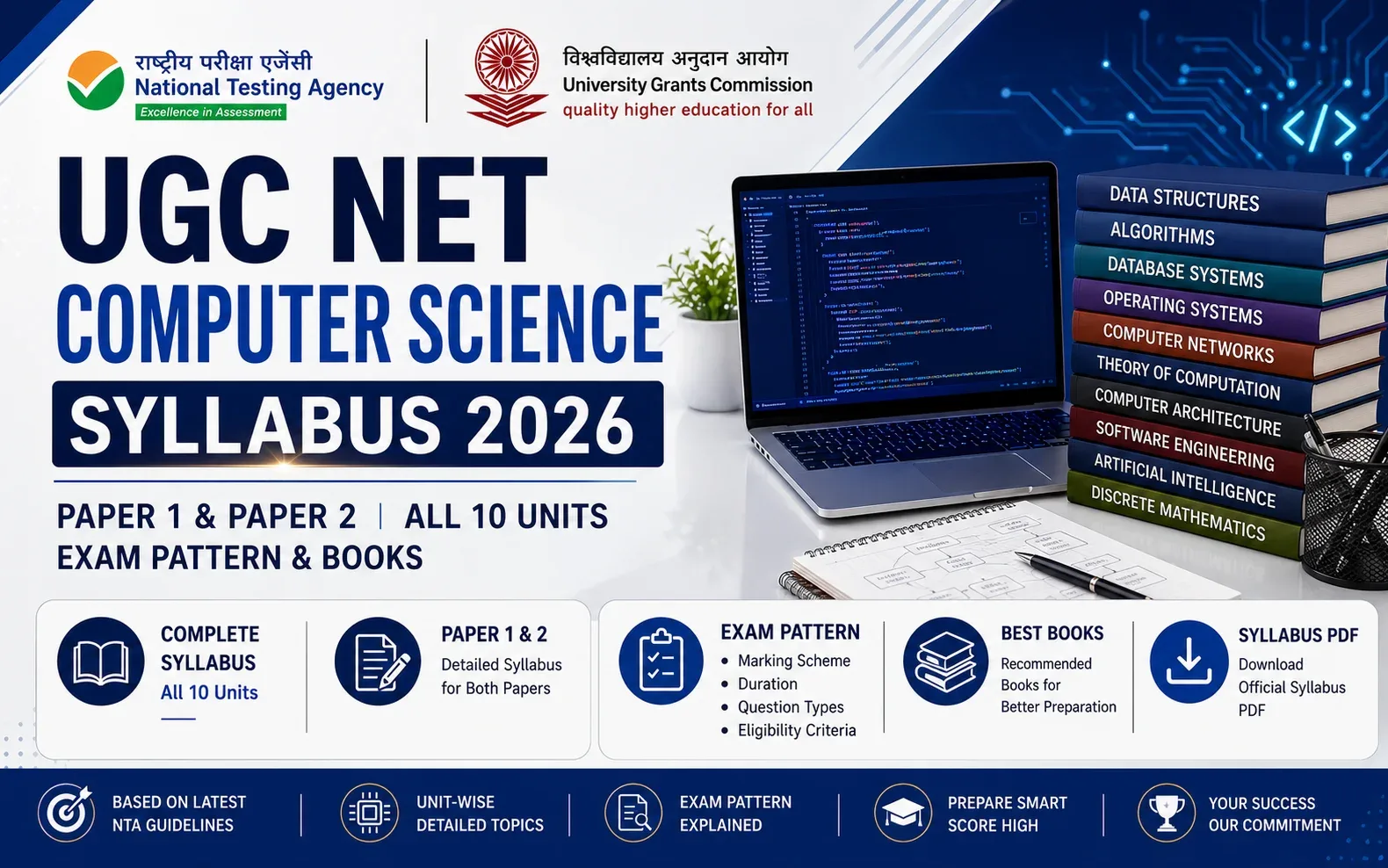
UGC NET Computer Science & Applications Syllabus 2026
Paper 1 & Paper 2 • All 10 Units • Exam Pattern • Best Books • Preparation Strategy
A clear understanding of the UGC NET Computer Science & Applications Syllabus 2026 is the first step toward smart preparation. Computer Science (Subject Code 87) is a highly technical subject covering everything from discrete mathematics and computer architecture to DBMS, operating systems, networks, algorithms and artificial intelligence. In this guide we explain the full syllabus for Paper 1 and Paper 2, break down all 10 units topic-by-topic, cover the exam pattern, list important topics and trusted books, and share a practical study plan — all in simple language.
UGC NET Computer Science 2026: Quick Highlights
UGC NET Computer Science Exam Pattern 2026
Both papers are held in one 3-hour session. Each correct answer gives +2 marks and there is no negative marking, so attempting all questions is worthwhile. Paper 2 alone carries 200 of the 300 total marks.
Paper 2: Computer Science Syllabus — All 10 Units
The Computer Science Paper 2 syllabus is divided into 10 technical units. Questions can be asked from any unit, so all must be covered. Here is a topic-wise breakdown:
Unit I • Discrete Structures and Optimization
- Mathematical logic – propositional and predicate logic, normal forms
- Sets, relations and partial ordering
- Counting, permutations, combinations and probability
- Group theory – groups, rings and fields
- Graph theory – trees, graph colouring, Eulerian and Hamiltonian graphs
- Boolean algebra and simplification
- Optimization – linear programming, simplex, transportation, PERT-CPM
Unit II • Computer System Architecture
- Digital logic – gates, flip-flops and sequential circuits
- Data representation and number systems
- Register transfer and micro-operations
- Computer organization – instruction cycle, interrupts
- CPU organization – addressing modes, RISC and CISC
- Memory hierarchy – cache, virtual and main memory
- Multiprocessors and cache coherence
Unit III • Programming Languages and Computer Graphics
- Language concepts and programming paradigms
- Programming in C – arrays, pointers, functions, files
- Object-oriented programming – class, inheritance, polymorphism
- Programming in C++ – templates, constructors, exception handling
- Web programming – HTML, XML, Java, servlets, applets
- Computer graphics – raster scanning, line drawing, polygon filling
- 2D and 3D transformations – rotation, scaling, projection
Unit IV • Database Management Systems
- Database concepts and DBMS architecture
- Data modeling – ER model, relational algebra, Codd’s rules
- SQL – queries, constraints, procedures, triggers
- Normalization and functional dependencies
- Advanced databases – distributed and XML databases
- Data mining – clustering, classification, regression
- Big Data and NoSQL – MapReduce, HDFS, Hadoop
Unit V • System Software and Operating System
- System software – assemblers, linkers, loaders
- OS basics – system calls, OS structure, boot process
- Process management and interprocess communication
- CPU scheduling – real-time and multi-core
- Deadlocks – prevention, detection and recovery
- Memory management – paging and segmentation
- Security – access control, cryptography, authentication
Unit VI • Software Engineering
- Process models – SDLC, Agile, Scrum, XP
- Software requirements and SRS
- Software design – modularity, coupling, cohesion
- Software quality – ISO standards, risk management
- Estimation – LOC, function points, COCOMO
- Testing – unit, black box, regression testing
- Configuration management and version control
Unit VII • Data Structures and Algorithms
- Data structures – arrays, trees, graphs, hashing
- Algorithm analysis – time and space complexity
- Design techniques – divide and conquer, greedy, dynamic programming
- Graph algorithms – BFS, DFS, shortest path
- Complexity theory – P, NP, NP-complete
- Advanced algorithms – FFT and approximation algorithms
Unit VIII • Theory of Computation and Compilers
- Formal languages and Church-Turing thesis
- Regular languages – DFA, NFA, regular expressions
- Context-free grammar – PDA, CNF, parse trees
- Turing machines and recursive languages
- Syntax analysis – LL(1), LR and LALR parsers
- Semantic analysis – attribute grammar, type checking
- Code generation and optimization
Unit IX • Data Communication and Computer Networks
- Data communication – bandwidth, transmission media, modulation
- Computer networks – LAN, WAN, wireless networks
- Network models – OSI and TCP/IP
- Internet protocols – IPv4, IPv6, TCP, UDP
- WWW concepts – DNS, SMTP, POP, FTP
- Network security – firewall, VPN, cryptography
- Cloud and IoT – SaaS, PaaS, IaaS, IoT basics
Unit X • Artificial Intelligence
- AI approaches – Turing test, rational agents
- Knowledge representation – semantic networks, ontologies
- Planning – goal stack planning, STRIPS
- Natural language processing – parsing, semantic analysis
- Multi-agent systems and the semantic web
- Fuzzy logic and membership functions
- Genetic algorithms and neural networks
High-Weightage & Important Topics
Based on previous-year analysis, some topics appear more frequently. Prioritise these while still covering the full syllabus:
- DBMS – ER modelling, normalization, transactions
- Data Structures – sorting techniques, dynamic programming
- Operating System – process scheduling, synchronization, deadlock, memory
- Computer Networks – IP addressing and protocols
- Theory of Computation – context-sensitive grammar and automata
- Software Engineering – development process, coding and testing
Best Books for UGC NET Computer Science 2026
- Graph Theory with Applications to Engineering and Computer Science – Narsingh Deo
- Computer Networks – Andrew S. Tanenbaum
- Operating System Concepts – Silberschatz, Galvin
- Database System Concepts – Korth & Sudarshan
- Trueman’s UGC NET Computer Science & previous-year papers
Tip: Build strong fundamentals first, then practise numerical and application-based questions through previous-year papers and mock tests.
How to Prepare: Smart Study Strategy
1. Follow the latest syllabus: Study strictly from the current NTA syllabus (Code 87) and list out all important topics first.
2. Set weekly goals: Divide the 10 units across weeks so the whole syllabus is covered with time for revision.
3. Strengthen core subjects: Focus on DBMS, OS, Data Structures, Networks and Theory of Computation – they carry heavy weightage.
4. Make short notes: Prepare concise notes and formula/definition sheets for quick last-minute revision.
5. Solve PYQs & mocks: Practise previous-year papers and take regular mock tests to understand the pattern and improve speed.