
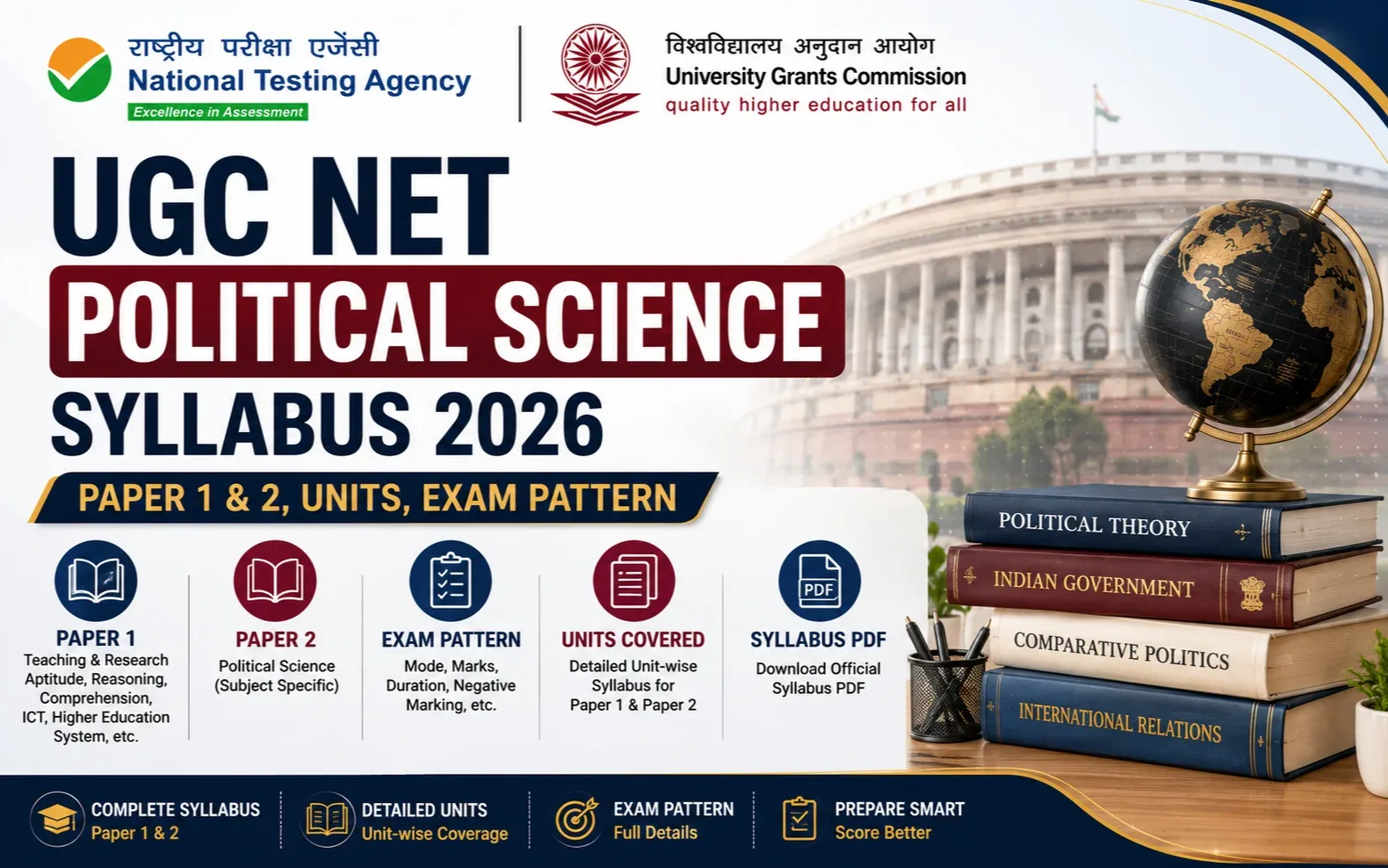
UGC NET Political Science Syllabus 2026
A complete, easy-to-understand guide to all 10 units, high-weightage topics, exam pattern, eligibility, best books and a smart study plan for Paper 1 & Paper 2.
Updated for 2026 • Cosmo Classes
Clearing the UGC NET in Political Science needs more than reading — it needs a clear map of what to study and how much weight each area carries. In this guide we break down the entire syllabus into simple, digestible parts so that you can plan your preparation, focus on high-scoring units, and walk into the exam with confidence. Whether your goal is Assistant Professor or Junior Research Fellowship (JRF), a strong grip on both papers is the key.
UGC NET Political Science 2026 – Quick Overview
The National Testing Agency (NTA) conducts UGC NET twice every year to shortlist eligible candidates for teaching roles in Indian universities and colleges. The Political Science paper checks how well you understand political theory, comparative politics, international relations, public administration and Indian government. Here is a snapshot before we dive deeper:
UGC NET Political Science 2026 Exam Pattern
Both papers are held in a single sitting and are fully objective (MCQ-based). Understanding the structure first helps you divide your time smartly between general aptitude and the subject paper. A big advantage in UGC NET is that there is no negative marking, so attempting every question is always worth it.
Paper 2: Political Science Syllabus — All 10 Units
Paper 2 is the heart of the exam. It is divided into ten units that move from core political ideas to institutions, world politics and governance. Here is a clear unit-wise breakdown:
Unit 1 • Political Theory
Core concepts such as liberty, equality, justice, rights, democracy, power and citizenship, along with modern ideologies like Marxism, Feminism and Multiculturalism.
Unit 2 • Western Political Thought
Key ideas of classical and modern thinkers — Plato (Justice), Aristotle, Hobbes, Locke and Rousseau (Social Contract), Gramsci (Hegemony) and Rawls (Justice as Fairness).
Unit 3 • Indian Political Thought
Governance philosophies from ancient to modern India — Dharmashastra, Kautilya, Pandita Ramabai, Gandhi, Ambedkar, Nehru and Savarkar.
Unit 4 • Comparative Political Analysis
Comparing world regimes and states, the institutional approach, New Institutionalism, elite theory, welfare state and models of economic development.
Unit 5 • International Relations
Classic IR theories (Realism, Liberalism, Constructivism, Marxism), global security, international organisations, WTO, G-20 and the global political economy.
Unit 6 • Foreign Policy of India
India’s non-alignment, neighbourhood-first and Look East/Act East policy, nuclear policy, the Gujral Doctrine and its multilateral partnerships.
Unit 7 • Political Institutions in India
Philosophy of the Constitution, Preamble, Fundamental Rights, DPSPs, Union Executive, Parliamentary committees, judicial review and federalism.
Unit 8 • Political Processes in India
Identity politics based on caste and religion, regionalism, social movements (Dalit, Tribal, Farmers), the party system and electoral behaviour.
Unit 9 • Public Administration
Theories of administration, models of bureaucracy, New Public Management, Human Relations Theory, decision-making, conflict management and accountability.
Unit 10 • Governance & Public Policy
Grassroots planning, welfare schemes (MGNREGA, RTE), RTI, Lokpal, NITI Aayog, Citizen’s Charter and the use of technology in governance.
High-Weightage Topics (Unit-Wise)
If you are short on time, these are the topics that appear most often and give you the best return for your effort. Prioritise them in your revision while still touching every unit at least once.
Best Books for UGC NET Political Science
Good books make preparation far smoother. Start with one or two core texts, then add references for depth. Do not pile up too many books – consistency with a few standard titles beats jumping between many.
Core Books
- Trueman’s UGC NET Political Science Paper II – a popular all-rounder.
- Arihant UGC NET Political Science – concise and exam-focused.
- O.P. Gauba – An Introduction to Political Theory for conceptual clarity.
- V.R. Mehta – for Indian political thinkers.
- Rajeev Bhargava & Ashok Acharya – Political Theory: An Introduction.
Additional References
- Andrew Heywood – Global Politics for IR (Unit 5).
- Rajiv Sikri – India’s Foreign Policy for Unit 6.
- Mohit Bhattacharya – Public Administration for Unit 9.
- Ronald Chilcote – Comparative Politics.
Smart Preparation Strategy
A 12-week plan works well for most serious aspirants. Split your time into three clear phases so that you build concepts first, then cover application-heavy areas, and finally sharpen your accuracy through practice.
Phase 1 (Weeks 1–4): Build a strong base with Units 1, 2 and 3 using core theory books.
Phase 2 (Weeks 5–8): Cover Indian polity, public policy and international relations while tracking current affairs.
Phase 3 (Weeks 9–12): Focus fully on previous year papers, mock tests and revision of high-weightage topics.
Explore More on Cosmo Classes
Keep your preparation moving with more free resources and guides: