UGC NET Education Syllabus 2026
A complete, easy-to-follow guide to all 10 units of Paper 2, the exam pattern, high-weightage topics and a smart preparation strategy for Assistant Professor & JRF aspirants.
Updated for 2026 • Cosmo Classes
The Education paper of UGC NET is one of the most popular subject choices, and for good reason — it opens the door to teaching and research careers in colleges and universities. The syllabus, set by the NTA, covers the foundations of education, learning and the learner, teacher education, curriculum, research methods, assessment, technology, management and inclusive education. In this guide we simplify the entire syllabus so you know exactly what to study and how to plan your preparation.
UGC NET Education 2026 – Quick Highlights
Before diving into the units, here is a snapshot of the key details for the Education subject paper:
UGC NET Education Exam Pattern 2026
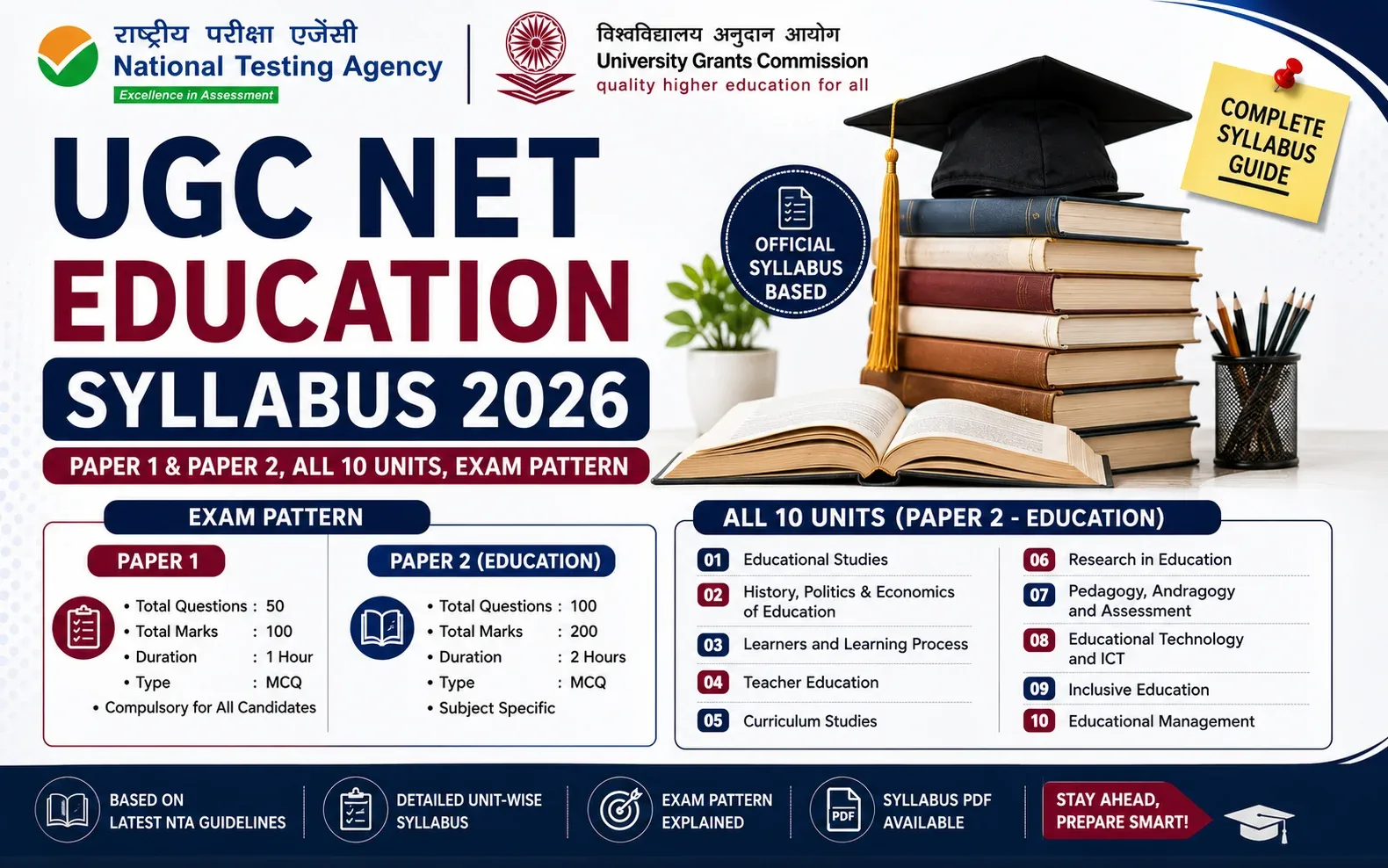
Both papers are held together in a single 3-hour session and are fully objective (MCQ). Since there is no negative marking, you should attempt every question. Here is how the two papers are structured:
Paper 2: Education Syllabus — All 10 Units
Paper 2 is divided into ten units that together cover the theory and practice of education. Here is a clear, unit-wise breakdown of what each unit contains:
Unit 1 • Educational Studies
Indian and Western schools of philosophy and their view of education, sociology of education, socialisation, major educational thinkers and constitutional values.
Unit 2 • History, Politics & Economics of Education
Key educational commissions and policies, the link between education and national development, the economics and finance of education, and the politics of education.
Unit 3 • Learner and Learning Process
Growth, development and personality, intelligence, creativity and critical thinking, theories of learning and social learning, plus guidance and counselling.
Unit 4 • Teacher Education
Concept and structure of teacher education, the knowledge base and reflective teaching, in-service training, professionalism, ethics and ICT integration.
Unit 5 • Curriculum Studies
Foundations and development of curriculum, models of curriculum design, curriculum transaction and evaluation, and curriculum change and research.
Unit 6 • Research in Education
Educational research and scientific method, variables, hypotheses and sampling, measurement scales and statistics, and qualitative and mixed-method designs.
Unit 7 • Pedagogy, Andragogy & Assessment
Pedagogy and teaching models, andragogy and self-directed learning, educational assessment and evaluation, and assessment within pedagogy and andragogy.
Unit 8 • Technology in / for Education
Educational technology and ICT, instructional design models, e-learning and emerging trends, and the use of ICT in evaluation, administration and research.
Unit 9 • Educational Management, Administration & Leadership
Educational management and administration, leadership theories and models, quality assurance in education, and change management.
Unit 10 • Inclusive Education
Concept and policies of inclusive education, disability and diverse learners, planning and managing inclusive classrooms, and barriers, facilitators and research trends.
High-Weightage Topics
Based on past-paper trends, certain areas appear more often than others. If you are short on time, give these priority while still covering every unit at least once.
Best Strategy to Finish the Syllabus
A phase-wise plan keeps your preparation organised and stress-free. Move through these five phases in order for the best results:
Phase 1: Complete all 10 units thoroughly using standard books.
Phase 2: Prepare short, revision-friendly notes for each unit.
Phase 3: Solve previous year questions unit by unit.
Phase 4: Attempt regular full-length mock tests.
Phase 5: Revise the high-weightage topics before the exam.
Education vs Physical Education – Don’t Confuse Them
Both subjects have 10 units, but their focus is completely different. Choose the paper that matches your postgraduate specialisation.
Explore More on Cosmo Classes
Keep your preparation moving with more free resources and guides: